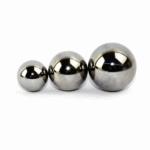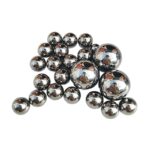
Cemented carbide balls, also known as hard alloy balls, are high-performance spherical components made by sintering a mixture of hard carbide phases (typically tungsten carbide, WC) and a metallic binder (usually cobalt, Co). Unlike stainless steel balls or carbon steel balls, they boast exceptional hardness, wear resistance, and high-temperature stability, making them ideal for extreme working conditions where ordinary materials fail to meet performance demands. Below is a detailed breakdown of their key knowledge points.
1. Core Definition & Material Composition
Cemented carbide balls derive their superior performance from their unique material structure, which combines the hardness of carbide phases with the toughness of the metallic binder.
① Key Components
Hard Phase: Tungsten carbide (WC) is the most common hard phase, accounting for 80–95% of the total composition. WC has an ultra-high Mohs hardness of ~9.5 (second only to diamond) and excellent wear resistance. Other hard phases (e.g., titanium carbide, TiC; tantalum carbide, TaC) may be added to enhance high-temperature resistance or corrosion resistance for specific applications.
Binder Phase: Cobalt (Co) is the standard binder, making up 5–20% of the composition. It forms a metallic matrix that bonds the WC particles together, improving the material’s toughness and ductility (preventing brittle fracture). Nickel (Ni) or iron (Fe) binders are occasionally used for corrosion-resistant scenarios (e.g., marine environments) but have lower toughness than Co.
② Common Grades & Performance Differences
Cemented carbide grades are classified by their binder content and hard phase composition, each tailored to specific application requirements:
Grade Type
Binder Content
Hardness (HRA)
Transverse Rupture Strength (TRS, MPa)
Key Performance
Typical Applications
High-Hardness Grade (e.g., YG6X)
6% Co
92.5–93.5
~1800
Excellent wear resistance, low toughness
Precision bearings, grinding media
Balanced Grade (e.g., YG8)
8% Co
91.5–92.5
~2000
Good balance of hardness and toughness
Valve seats, pump rotors
High-Toughness Grade (e.g., YG15)
15% Co
89.5–90.5
~2400
High impact resistance, moderate wear resistance
Rock drilling bits, shot blasting nozzles
2. Key Manufacturing Processes
The production of cemented carbide balls requires advanced powder metallurgy techniques to ensure uniform particle distribution, high density, and precise dimensions.
Similar Posts
Comprehensive Knowledge About Rolling Bearing Steel Balls
Rolling bearing steel balls are core components of rolling bearings, playing a critical role in reducing friction, supporting loads, and ensuring smooth rotational motion in mechanical systems. Below is…
Comprehensive Knowledge About Stainless Steel Balls
Stainless steel balls are spherical components made of stainless steel, a corrosion-resistant alloy containing chromium (at least 10.5%) as the core anti-rust element. Unlike ordinary carbon steel balls, they…