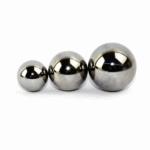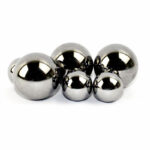
Stainless steel balls are spherical components made of stainless steel, a corrosion-resistant alloy containing chromium (at least 10.5%) as the core anti-rust element. Unlike ordinary carbon steel balls, they excel in harsh environments with moisture, chemicals, or oxidation risks, making them indispensable in industries where durability and rust resistance are critical. Below is a detailed breakdown of their key knowledge points.
1. Core Definition & Classification by Material
Stainless steel balls are categorized based on their stainless steel grade, each with unique chemical compositions and performance characteristics to suit different application scenarios:
① Austenitic Stainless Steel Balls (Most Common)
Typical Grades: AISI 304 (1.4301), AISI 316 (1.4401), AISI 316L (1.4404)
Chemical Features: High chromium (16–18% for 304, 16–18% for 316) and nickel (8–10% for 304, 10–14% for 316) content; 316/316L adds molybdenum (2–3%) for enhanced corrosion resistance.
Performance: Non-magnetic (or weakly magnetic after processing), excellent ductility, and superior resistance to general corrosion (e.g., water, air, weak acids). 316/316L outperforms 304 in saltwater, marine, and chemical environments.
Hardness: Low to medium (HRC 25–35 for annealed state); suitable for non-high-wear scenarios (e.g., food processing, medical equipment).
② Martensitic Stainless Steel Balls
Typical Grades: AISI 440C (1.4125), AISI 420 (1.4021)
Chemical Features: High carbon (0.95–1.2% for 440C, 0.15–0.25% for 420) and chromium (16–18% for 440C, 12–14% for 420) content; no nickel.
Performance: Magnetic, can be hardened via heat treatment, and has high wear resistance. 440C is the hardest common stainless steel grade (HRC 58–62 after quenching/tempering), balancing corrosion resistance and hardness.
Application: Scenarios requiring both rust resistance and wear resistance (e.g., precision bearings, valves, pumps).
③ Ferritic Stainless Steel Balls
Typical Grades: AISI 430 (1.4016)
Chemical Features: High chromium (16–18%), low carbon (<0.12%), no nickel.
Performance: Magnetic, good corrosion resistance in mild environments (e.g., indoor air), but lower ductility than austenitic grades.
Hardness: Medium (HRC 30–40); used in low-cost, non-critical corrosion-resistant applications (e.g., decorative parts, low-load bearings).
2. Key Manufacturing Processes
The production of stainless steel balls follows strict procedures to ensure dimensional accuracy, surface quality, and material performance.
Similar Posts
Comprehensive Knowledge About Rolling Bearing Steel Balls
Rolling bearing steel balls are core components of rolling bearings, playing a critical role in reducing friction, supporting loads, and ensuring smooth rotational motion in mechanical systems. Below is…
Comprehensive Knowledge About Cemented Carbide Balls
Cemented carbide balls, also known as hard alloy balls, are high-performance spherical components made by sintering a mixture of hard carbide phases (typically tungsten carbide, WC) and a…