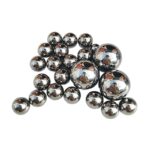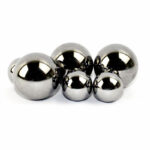
Rolling bearing steel balls are core components of rolling bearings, playing a critical role in reducing friction, supporting loads, and ensuring smooth rotational motion in mechanical systems. Below is a detailed breakdown of their key knowledge points, covering materials, manufacturing, performance, and applications.
1. Definition & Core Function
A rolling bearing steel ball is a spherical precision component designed for use in rolling bearings (e.g., deep groove ball bearings, angular contact ball bearings). Its primary functions include:
Enabling rolling friction between the bearing’s inner ring (rotating with the shaft) and outer ring (fixed or rotating), replacing sliding friction to reduce energy loss and wear.
Uniformly distributing radial and axial loads across the bearing, preventing localized stress concentrations that could damage the bearing or shaft.
Maintaining the concentricity of the bearing’s inner and outer rings, ensuring stable rotational accuracy (e.g., minimizing runout in high-speed equipment).
2. Material Selection: Why High-Quality Steel Matters
The performance of rolling bearing steel balls depends heavily on their material—they must withstand high pressure, wear, and fatigue. The most commonly used materials globally are:
① Bearing Steel (Primary Choice)
Standard Grades:
SUJ2 (JIS, Japan) / SAE 52100 (ASTM, U.S.) / 100Cr6 (DIN, Germany): The most widely adopted bearing steel. It contains ~1% carbon and ~1.5% chromium, which enhances hardenability, wear resistance, and fatigue strength. After heat treatment (quenching + tempering), its surface hardness reaches HRC 60–65 (Rockwell hardness), enabling it to withstand contact pressures up to 3,000–4,000 MPa.
High-Cleanliness Bearing Steel: Advanced grades (e.g., SUJ2-HT, 100Cr6H) with lower impurity content (e.g., reduced oxygen, sulfur, and non-metallic inclusions). These materials improve fatigue life by 2–3 times compared to standard bearing steel, making them suitable for high-speed, long-life applications (e.g., aerospace engines, wind turbine bearings).
② Special Materials for Extreme Conditions
Stainless Steel: For corrosive environments (e.g., food processing, marine equipment). Common grades include AISI 440C (hardness HRC 58–62, good corrosion resistance) and AISI 316 (lower hardness but excellent resistance to saltwater and chemicals).
Ceramic Composites: For high-temperature, high-speed, or non-magnetic applications. Materials like silicon nitride (Si₃N₄) or zirconia (ZrO₂) offer low density (reducing centrifugal force at high speeds), high temperature resistance (up to 800°C for Si₃N₄), and non-magnetism (critical for medical or semiconductor equipment).
3. Manufacturing Process: Precision from Raw Material to Finished Ball
The production of rolling bearing steel balls requires strict control to ensure roundness, surface quality, and dimensional accuracy.
Similar Posts
Comprehensive Knowledge About Stainless Steel Balls
Stainless steel balls are spherical components made of stainless steel, a corrosion-resistant alloy containing chromium (at least 10.5%) as the core anti-rust element. Unlike ordinary carbon steel balls, they…
Comprehensive Knowledge About Cemented Carbide Balls
Cemented carbide balls, also known as hard alloy balls, are high-performance spherical components made by sintering a mixture of hard carbide phases (typically tungsten carbide, WC) and a…